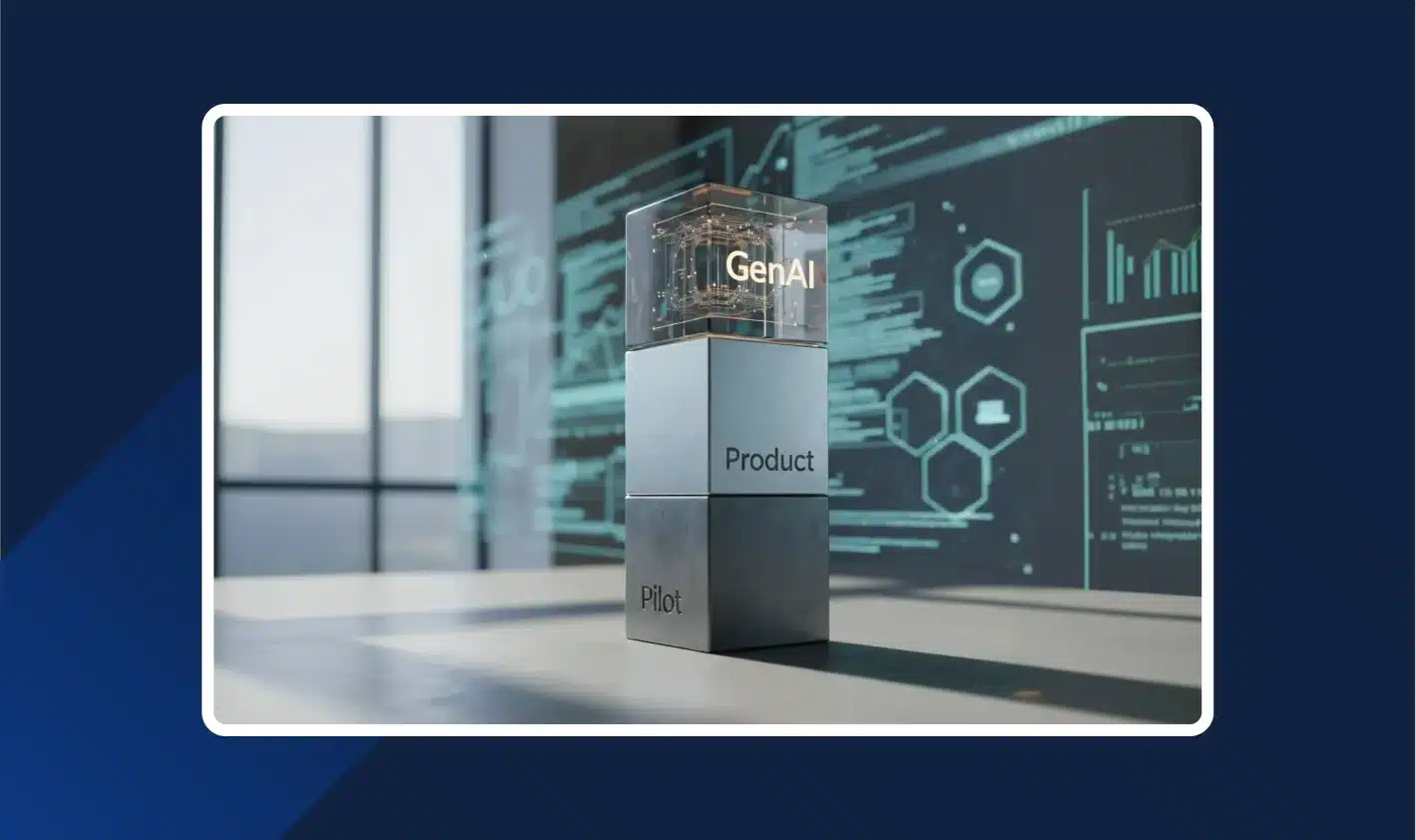
Most GenAI pilots don’t fail because the model is “bad.”
They fail because the pilot never becomes an owned product.
A pilot can survive on goodwill and a few smart people. Production can’t. Production needs clear decision rights, routine maintenance, and a review loop that doesn’t depend on who has time this week.
And the numbers back that up. Across major reports from 2023–2026, enterprise AI and GenAI pilots that don’t make it to production commonly fall in a wide failure band—roughly 50% to 95% depending on the study, industry, and what each report counts as “production.”
That range sounds messy, but the pattern is consistent: experimentation is easy; operational ownership is hard.
So let’s talk about the one thing most teams skip: a simple ownership map.
“Production” is not a button. It’s a responsibility.
When leaders say “move this to production,” many teams hear “deploy it.”
But production is a bundle of commitments:
- Data stays trustworthy (freshness, permissions, lineage, retention).
- Quality is defined and repeatable (tests, acceptance criteria, regression checks).
- Risk is controlled (PII, IP, security reviews, audit trails).
- Operations exist (monitoring, incident response, cost controls).
- People actually use it (workflow changes, training, feedback loops).
Here’s the uncomfortable part: pilots rarely assign ownership across all of this. They assign it across parts. That’s how you end up in “POC limbo.”
And there are signals that this is the common failure mode: multiple reports attribute a large share of post-pilot failure to data problems (quality, governance, integration), often cited in the 70–80% band.
Where ownership quietly breaks (and pilots stall)
1) Data: “Who owns the inputs?” becomes a fight later
A pilot often uses a convenient dataset, a quick export, or a one-time dump.
Then production asks basic questions:
- Who approved these sources?
- Who maintains the pipeline and access rules?
- Who owns definitions when two systems disagree?
- Who decides what “current” means for this workflow?
If nobody has clear authority, you get delays, security blocks, and constant rework.
Also, poor data is not a small tax. Recent estimates put the average annual cost of poor data quality per organization around $9.7M–$12.9M (depending on the source and method), driven by rework, lost productivity, missed opportunities, and compliance exposure.
That’s not an “AI issue.” It’s a business issue that AI makes visible.
2) Quality: “It looked fine in the demo” is not a release standard
GenAI needs an answer to one question: What does “good” mean here?
Not “good vibes.” Actual criteria:
- What error rate is acceptable?
- What cases must be escalated to a human?
- What must be refused?
- What is the rollback trigger?
Many enterprise teams now use a mix of automated checks, curated evaluation sets, and adversarial testing (red teaming) to reduce failure modes like hallucinations, unsafe outputs, and drift.
But those practices only work if someone owns them. Otherwise, quality becomes a debate, not a gate.
3) Change management: the tool exists, but the work doesn’t change
This is the part leadership often underestimates.
A pilot can be “used” by a small group who already care.
Production needs adoption across teams that have deadlines, habits, and muscle memory.
If nobody owns:
- workflow redesign,
- enablement,
- feedback triage,
- and support,
then usage stays patchy. Some recent research also points to high abandonment of AI initiatives when integration and adoption are weak, even after a pilot appears successful.
The simple ownership map: Decide, Maintain, Review
If you remember one framework from this blog, make it this:
Decide — who has decision rights?
Examples: approve data sources, approve launch, approve changes, approve rollback.
Maintain — who keeps it running week after week?
Examples: pipelines, prompts/RAG configs, access rules, monitoring, cost limits.
Review — who checks that it is still safe and still useful?
Examples: periodic quality review, risk review, audit artifacts, drift and incident reviews.
This is boring. And it’s exactly why it works.
Standards and governance frameworks also push in this direction by requiring documented accountability and lifecycle oversight (not just model building).
A RACI-style ownership map you can actually use
Below is a compact RACI you can adapt. Keep roles simple. Titles vary across companies, but responsibilities don’t.
Roles
- Exec Sponsor (CTO/CIO/CAIO)
- Business Owner (owns the workflow outcome)
- GenAI Product Owner (single “A” across the lifecycle)
- Data Owner/Steward
- Engineering Lead (app + platform)
- ML/GenAI Lead
- Security/Privacy
- Legal/Compliance
- Ops/SRE
- Change Lead (enablement + adoption)
R = Responsible | A = Accountable | C = Consulted | I = Informed
| Workflow activity | Business Owner | GenAI Product Owner | Data Owner | ML/GenAI Lead | Engineering Lead | Security/Privacy | Legal/Compliance | Ops/SRE | Change Lead |
| Define outcome + KPI (what “success” means) | A | R | C | C | C | I | I | I | C |
| Approve data sources + access rules | C | A | R | C | I | C | C | I | I |
| Build/maintain data pipelines + permissions + retention | I | A | C | I | R | C | C | C | I |
| Define quality gate (rubric, eval set, pass/fail) | A | R | C | R | C | C | I | I | C |
| Security/privacy controls + logging | I | A | C | C | C | R | C | R | I |
| Production release + rollback decision | I | A | I | C | R | C | C | R | I |
| Adoption plan (workflow change, training, support loop) | A | R | I | C | C | I | I | I | R |
Rule of thumb: If your GenAI Product Owner is not accountable across data, quality, and adoption decisions, you will ship fragments. And fragments don’t survive production.
The “before you scale” checklist: assign these 10 decisions
If you’re about to expand a pilot, pause and assign owners for:
- Which data sources are allowed
- Who can add a new source
- What the quality gate is (and how it’s measured)
- Who approves prompt/RAG changes
- What gets escalated to humans
- Who owns incident response and rollback
- Who owns cost limits and usage controls
- Who owns logging, access, and audit needs
- Who owns training and enablement
- Who owns ongoing review (monthly/quarterly)
If any of these answers is “we’ll figure it out later,” you already know what happens next.
Closing thought: pilots prove possibility; ownership proves value
It’s tempting to treat pilot-to-production as a tech maturity problem.
Often it’s a management clarity problem.
So take the simplest step that changes everything: write the ownership map, publish it, and run your GenAI work like a product, not a science fair.
If you’re planning to move a GenAI pilot into production, Amazatic can help you set the ownership model, quality gates, and operating cadence so rollout doesn’t depend on heroics.