What Managing Multiple IoT Vendors Actually Costs You

You signed four sensible contracts. A hardware firm for the device. A firmware team for the code. A cloud provider for the platform. An app studio for the interface. Each one was the right call on its own. And now? Most of your week goes into status calls, chase-up emails, and figuring out whose problem the latest bug actually is. The vendors were the cheap part. Managing them is what’s quietly draining you.

Here’s the short answer for anyone skimming: the real cost of running multiple IoT vendors isn’t in their invoices. It’s in the coordination, the delays, and your own time, and it rarely shows up as a line item until it’s already hurt you.

Why splitting the work looks smart

Let me be fair to the decision first. An IoT product needs hardware, firmware, connectivity, cloud, and analytics, and as STL Partners points out, that’s a spread of skills you almost never find in one engineer. So you hire specialists. Makes sense. On paper.

The trouble is that the bill for coordination never lands on any one desk. It hides in the gaps between your vendors, and those gaps get more expensive the more of them you have.

Where the money actually goes

Start with your time, because that’s the cost founders feel first. One study found that 25% of IT time gets spent just managing vendors, and that 94% of executives say manual vendor management leads to poor spending decisions (Spendesk, 2025). A quarter of your team’s attention, gone to herding suppliers instead of building the product. Nobody budgets for that. Everybody pays it.

Then there’s delay, and this is where IoT gets brutal. Internal, multi-vendor IoT projects run 40 to 60% over their timelines on average, so a six-month deployment quietly becomes ten (s2s Communications, 2026). And the opportunity cost while everyone waits, leadership refereeing vendor disputes, ops managers stuck babysitting installs, lands somewhere between $15,000 and $25,000 a month for a mid-sized deployment (s2s Communications, 2026). Again, none of that appears in the original budget.

When your vendors point at each other, you’re the one holding the customer. And the clock.

Why do the delays happen? Because every vendor you add is another seam. As one implementation team put it, the more components you connect, the more interactions there are between them, and even a small mismatch in data formats or timing can break the flow and cause failures that are hard to trace (Bamboo Agile, 2026). That’s the blame game in a sentence. Nobody’s lying. Everybody’s a little bit right. And you lose weeks finding the root cause anyway.

It compounds, too. The setup that runs fine with two or three vendors, as one procurement analysis notes, fundamentally breaks at ten or more (Inch Creative, 2026). And value keeps leaking even after the ink dries. A recent World Commerce & Contracting report found that procurement contracts lose an average of 11% of their value after signing, thanks to poor governance, missed renewals, and unclear ownership (WorldCC, January 2026). Split that ownership across five vendors and you can guess which way that number moves.

The part that should keep a founder up at night

Now zoom out, because this is bigger than annoyance. It’s about the runway.

The baseline time-to-market for a new IoT product has stretched to 41 months from kickoff to first paying customer, up from 23 months back in 2020, with the proof-of-concept-to-revenue gap alone averaging almost 23 months (IoT Analytics 2024 Commercialization Report, via TechStory). Sit that next to the money. The median gap from seed to Series A is now 2.2 years, and most hardware founders plan for roughly 24 months of cash (Carta, State of Seed 2025). See the problem? The standard IoT launch already outruns the runway most founders have.

And when the cash runs out, the story ends. CB Insights found that running out of money is the number one reason startups fail, at 38%. So every month your vendors spend pointing fingers isn’t just a delay. It’s a bite out of the one resource you can’t refill.

Runway isn’t a budget. It’s a deadline.

So what actually helps

I’ll say the obvious thing, then the useful thing. The obvious thing: fewer vendors, less coordination. It’s why so many companies are now trying to cut their vendor count by 20% (Proven IT, 2026).

The useful thing is a little different. It’s not really about the number of vendors. It’s about who owns the outcome. When one team is answerable for the whole product, the seams stop being your problem. There’s one root cause instead of five, one contract instead of a pile, and one partner you can reach in your hours when something breaks. Familiarity with your market, closeness you can actually call on, and coverage across the whole build. That’s what turns coordination back into building.

Because here’s the thing you already know in your gut. You didn’t start a company to manage vendors. You started it to ship a product. The coordination was never supposed to be the job.


Want the full picture, including what the coordination trap costs across the entire prototype-to-production journey? Read our whitepaper.

Frequently Asked Questions


What does it actually cost to manage multiple IoT vendors?

The biggest costs aren’t the invoices, they’re coordination and time. Around 25% of IT time goes to managing vendors (Spendesk, 2025), and multi-vendor IoT projects run 40 to 60% over their timelines, carrying $15,000 to $25,000 a month in opportunity cost for a mid-sized deployment (s2s Communications, 2026).

Why do IoT products get delayed when several vendors are involved?

Every vendor adds a seam, and the more components you connect, the more ways they can misalign. Even a small mismatch in data formats or timing can break the flow and cause failures that are hard to trace (Bamboo Agile, 2026). Diagnosing those failures across separate vendors is where the weeks disappear.

How many IoT vendors is too many?

There’s no fixed number, but coordination that works fine with two or three vendors tends to break down at ten or more (Inch Creative, 2026). The real question isn’t the count, it’s whether a single team is accountable for the whole product or whether that job has quietly landed on you.

Is it cheaper to use one IoT partner or several specialists?

Several specialists often look cheaper on the quote, but the total cost tells a different story once you add coordination time, delays, and contract value lost to unclear ownership, which averages 11% after signing (WorldCC, January 2026). One accountable partner usually wins on total cost and time to market, even when the headline price looks higher.

AI Integration Services: Connecting Artificial Intelligence with Existing Business Systems

AI delivers the most value when it works with the systems a business already relies on. Instead of replacing established tools, organisations can connect AI with CRM platforms, ERP software, databases, customer service tools and internal workflows. AI integration services make this possible by creating secure links between AI models and business applications, allowing information and actions to move between them in a controlled way.

How AI Integration Connects Models with Core Business Workflows

AI integration services connect models, applications and data so that intelligent capabilities can become part of everyday operations. APIs, integration platforms, event-driven workflows and secure data pipelines can link AI tools with existing systems, depending on the architecture and business requirements.

For example, an AI assistant could retrieve approved customer information from a CRM, summarise it and return a useful response without requiring employees to switch between multiple applications. Similarly, AI can support document processing, forecasting, classification, search and workflow automation when it has appropriate access to relevant business data.

What Businesses Gain from Smarter System Connectivity

The main advantage of AI system integration is not simply adding an AI feature. It is making that capability useful within the processes employees already understand. Proper integration can reduce repetitive manual work, improve access to information and support faster decisions.

Common applications include:

  • Connecting AI assistants with CRM and helpdesk platforms.
  • Using AI to classify or summarise business documents.
  • Adding intelligent search to internal knowledge bases.
  • Triggering workflows from AI-generated classifications or recommendations.
  • Connecting predictive models with operational dashboards and applications.

The right use case depends on data quality, workflow complexity, security requirements and the level of human oversight needed.

Building Secure and Reliable AI Connections

Successful integration needs more than a working API. Businesses should define authentication, authorisation, data access rules, monitoring, error handling and audit requirements before production deployment. Sensitive information should only be exposed to AI components when there is a legitimate business need and appropriate controls.

API gateways, access policies and observability tools can help organisations manage AI endpoints and monitor usage. Testing should also cover inaccurate outputs, unexpected inputs, failures and performance. Human review remains important for high-impact decisions or workflows where an incorrect AI output could create material risk.

Planning a Practical Business AI Integration Strategy

A sensible approach starts with one clearly defined business problem rather than attempting to connect AI to every system at once. Teams can map the existing workflow, identify the data and applications involved, choose an appropriate integration pattern and establish measurable outcomes.

A pilot can then be tested with controlled data and limited users before wider deployment. Once the workflow proves reliable, organisations can expand the integration while continuously reviewing security, costs, performance and user feedback.

Closing Insights

AI becomes considerably more useful when it is connected to the systems, data and workflows that already run the business. With thoughtful architecture, strong governance and ongoing monitoring, AI can become a practical part of everyday operations rather than a disconnected experiment. For organisations planning this transition, Amazatic can help turn AI integration services into secure, scalable and business-focused solutions.

Frequently Asked Questions


1. What are AI integration services?

AI integration services connect artificial intelligence tools with existing business applications, data sources and workflows. They can help organisations automate repetitive tasks, improve information access and add intelligent capabilities without rebuilding their entire technology environment from scratch, while maintaining appropriate security and operational controls.

2. Can AI be integrated with existing CRM or ERP software?

Yes. AI can connect with CRM, ERP and other business platforms through APIs, connectors or integration middleware. The approach depends on the software architecture, available interfaces, data permissions and the specific workflow the organisation wants to improve safely and efficiently.

3. What are the benefits of AI system integration?

AI system integration can reduce manual data handling, streamline workflows and make relevant information easier to access. It can also help teams use AI within familiar applications, provided the integration includes suitable security controls, testing, monitoring and human oversight for appropriate business processes.

4. Is AI integration suitable for small businesses?

Yes. Small businesses can begin with a focused use case, such as customer support, document processing or internal search. Starting small helps control implementation costs, test results, and identify practical improvements before expanding AI across additional workflows or systems, without creating unnecessary technical complexity.

5. How should a business start with business AI integration?

Start by selecting a measurable business problem and mapping the systems, data and people involved. Define security requirements, choose an appropriate integration approach, test it with controlled data and monitor results before expanding the solution to additional workflows across the organisation.

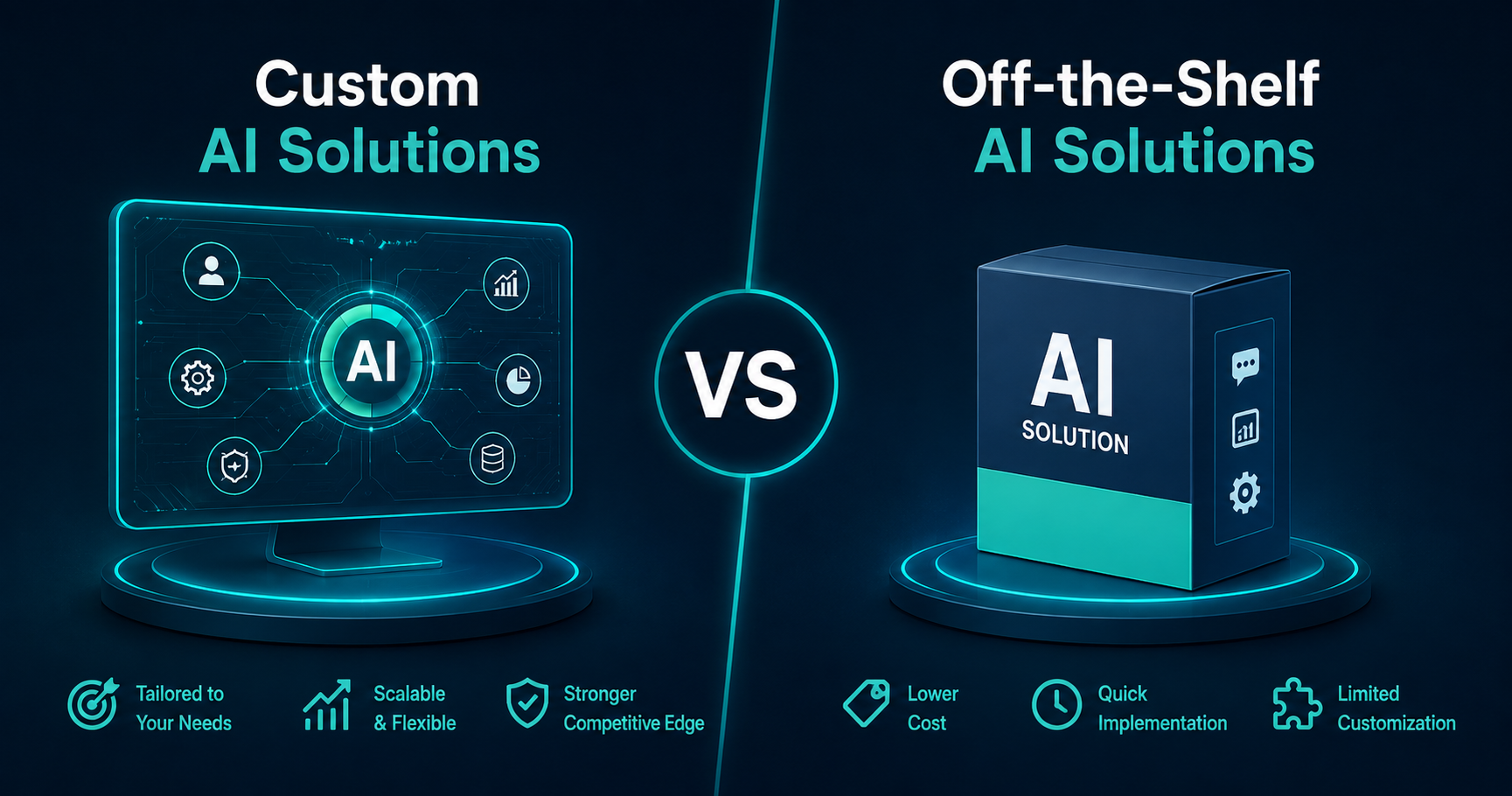
Custom AI Solutions vs Off-the-Shelf AI: Which Is Right for Your Business?

AI isn’t just for big enterprises anymore. Small teams and solo operators are building custom AI solutions into their workflows now, mostly to make sense of data they already had but never used well. Still, there’s a fork most businesses hit sooner or later: pay for something ready-made, or get something built for you. A custom AI solution costs more and takes longer, but it bends around your business rather than the other way round.

Understanding Custom AI Development

Think of custom AI development as software with no template to start from. A developer learns how your business works, then builds around that. What tends to push a company toward bespoke AI:

  • Automation matched to a specific industry’s rules
  • Insight pulled from data nobody else has
  • Customer experiences that feel personal, not scripted
  • Compliance requirements baked in, not bolted on afterwards

None of this is cheap or fast. Done right, though, the payoff usually dwarfs what a generic tool could have delivered.

What Off-the-Shelf AI Software Actually Gets You

Chatbots, document automation, analytics dashboards, content generators. Off-the-shelf AI software handles problems every business runs into, so somebody’s already built the fix. Sign up, tweak a few settings, done. Fast to implement, predictable pricing, and the vendor handles updates, which is usually where people starting with AI begin.

Where Flexibility Actually Comes From

Pre-built software was designed for thousands of businesses, not yours specifically, so you’ll configure a few things, but mostly you’re the one adapting. Custom AI platforms work the other way round: nobody writes a line of code until they understand what you’re trying to fix, which usually means better adoption and results.

The Real Cost Conversation

Off-the-shelf platforms spread development cost across every subscriber, which is why they’re cheaper on day one. AI software solutions built from the ground up don’t have that luxury, given the research and integration behind them. What gets missed is what happens after launch: fewer wasted hours, better margins, room to grow. A well-built system often pays for itself, just not immediately.

What Happens When You Outgrow the Tool

Off-the-shelf platforms only move as fast as the vendor lets them, and most businesses eventually hit a wall- some feature they need that isn’t on the roadmap. Bespoke AI solutions don’t have that ceiling; want another integration, build it. That headroom matters most for companies planning to grow into their AI, not just use it as-is.

Who Actually Owns Your Data?

This matters more than people give it credit for, especially in finance, healthcare or legal work. Off-the-shelf platforms usually run on shared infrastructure, and while reputable vendors keep it secure, you’re working within their framework. Build something tailored, and compliance gets designed in from day one rather than squeezed in afterwards. That’s real ownership, not just a login.

Making the Call

Go off-the-shelf if speed matters more than fit, requirements are fairly standard, or budget is tight. Go with custom AI solutions if the functionality has to be industry-specific, wired into systems you already run, or you’re handling sensitive data. Nobody wins points for the flashiest option; the ones that actually work are built around what the business needed in the first place.

Where This Leaves You

There’s no universal right answer, only the one that fits your situation. Off-the-shelf AI wins on speed and cost, while custom AI solutions win on fit, control, and how far they can grow with you. At Amazatic, we sit down with businesses, work out where they stand with AI, and build something that matches what they’re trying to achieve.

Frequently Asked Questions

1. What are custom AI solutions, and who should use them?

Custom AI solutions are built around a specific business rather than pulled off a shelf. They suit companies with unusual workflows or tight compliance needs, and tend to integrate better, scale further, and pay off more over time than generic software ever could.

2. Are off-the-shelf AI tools suitable for small businesses?

Often, yes. Off-the-shelf AI tools get small teams up and running fast without a big upfront spend, covering most common tasks out of the box. Plenty of businesses start here and move to something tailored once their needs get more specific.

3. What’s the difference between bespoke AI solutions and standard AI software?

Mostly it comes down to fit. Bespoke AI solutions are shaped around one company’s exact requirements; standard software offers the same fixed feature set to everyone. Custom builds simply give you more say over integration, control, and how the system adapts later.

4. How long does it take to develop a custom AI solution?

Depends on the scope. A focused custom AI project might take a few weeks, while something enterprise-wide can run several months once integrations and testing are factored in. Rushing this stage rarely ends well.

5. How can businesses decide between custom and ready-made AI?

Look at your budget, your infrastructure, and how sensitive your data is. If your advantage comes from something nobody else has, whether that’s a workflow or a dataset, custom AI solutions usually beat generic platforms on long-term value.

Enterprise AI Solutions: Transforming Large-Scale Business Operations

Efficiency, cost control, faster response times — these aren’t nice-to-haves anymore. They’re what keeps a business competitive. Yet the systems many organisations still lean on simply weren’t built for today’s data volumes or the complexity of modern workflows. That gap is exactly where enterprise AI solutions step in. Pair intelligent automation with predictive analytics and machine learning, and you get operations that run smoother, decisions that come faster, and growth opportunities that used to slip through the cracks. And no, this isn’t about replacing your people — it’s about freeing them from the repetitive, data-heavy grind so they can focus on work that actually needs a human mind.

How Do Enterprise AI Solutions Improve Business Operations? 

In short: enterprise AI solutions take repetitive processes off your team’s plate, make sense of huge datasets, sharpen customer experiences and speed up decision-making. The payoff is higher productivity, lower operational costs, and the kind of scalability that doesn’t come at the expense of accuracy or compliance.

Why AI Solutions for Enterprises Are Becoming a Strategic Priority

Digital transformation used to mean moving to the cloud or swapping out old software. Not anymore. Businesses now need systems that can actually interpret data, spot patterns, and suggest what to do next — in real time. That’s the promise behind AI solutions for enterprises weaving artificial intelligence into everyday business functions so teams work smarter, not just harder.

Whether it’s finance, healthcare, manufacturing, retail or logistics, companies are turning to AI to sharpen forecasting, allocate resources better, and personalise how they engage customers. The upshot? Operations that bend without breaking, and businesses that adapt quickly when markets shift under their feet.

Driving Efficiency Through Enterprise Automation

Here’s where AI really earns its keep: enterprise automation. Invoice processing, document management, inventory tracking, customer support — tasks like these can now run through intelligent workflows instead of human hands, cutting down on manual effort and the errors that come with it.

There’s a knock-on effect too. Faster turnaround times mean employees get more room to focus on innovation, strategy, and actual customer relationships. AI isn’t stepping into anyone’s job here — it’s taking the repetitive parts off their desk so their expertise counts for more.

Where Enterprise AI Creates the Greatest Business Value

Companies are rolling AI out across the board, not just in one department, to tackle real operational headaches. Some of the most common applications:

  • Intelligent customer service through AI-powered assistants
  • Predictive maintenance on manufacturing equipment
  • Demand forecasting and inventory optimisation
  • Fraud detection within financial services
  • Automated document processing
  • Supply chain optimisation
  • Sales and marketing personalisation
  • Workforce planning and resource allocation

Each one is proof that AI isn’t just theoretical — it delivers results you can measure, while still supporting growth that lasts.

Building Smarter Decisions with Data-Driven Intelligence

Every business sits on a mountain of data. The hard part is turning it into something useful. Modern AI platforms comb through structured and unstructured data at scale, surfacing trends that would otherwise stay buried.

That means leadership teams can sharpen forecasts, manage risk more effectively, and make calls based on what’s happening now — not just what a quarterly report said six months ago. It’s the difference between reacting to the market and staying a step ahead of it.

Key Considerations Before Implementing Enterprise AI

Picking the right technology is only half the job. Before rolling out enterprise AI, organisations need to pin down which business problems they’re actually solving, set objectives that can be measured, and make sure the data feeding the system is solid. Governance, cybersecurity and regulatory compliance matter just as much — skip these and you risk losing the trust you’re trying to build.

People matter here too. Bring employees into the process early, train them to work alongside these systems, and adoption follows naturally, along with a stronger return on investment.

The Future of Enterprise AI Solutions

Generative AI, intelligent agents, predictive analytics — the field keeps moving, and fast. Businesses that treat AI as a strategic asset rather than a passing trend are the ones positioned to innovate, sharpen customer experience, and respond with confidence when the market shifts.

This isn’t a short-lived technology wave. AI is fast becoming a core business capability, and organisations investing in scalable, secure, responsibly-built AI now are setting themselves up for a real edge down the line.

Key Takeaway

Enterprise AI solutions are reshaping how organisations run their operations, read their data, and deliver value to the people they serve. Whether it’s streamlining work through enterprise automation or making smarter calls with AI solutions for enterprises, businesses are becoming more agile, efficient and ready for whatever comes next.

At Amazatic, we help organisations put enterprise AI to work through solutions built around their actual goals, operations and long-term transformation plans. Whether you’re just starting or scaling up what you’ve already built, the right approach makes all the difference.

Frequently Asked Questions

1. What are enterprise AI solutions?

Enterprise AI solutions are AI-driven systems built to run large-scale operations more efficiently. They automate repetitive tasks, make sense of complex data, support sharper decisions and lift productivity across every department, helping businesses stay competitive as markets keep shifting fast.

2. How do AI solutions for enterprises improve productivity?

AI solutions for enterprises streamline everyday workflows by automating routine tasks and cutting manual effort. Teams get real, actionable insights instead of guesswork, freeing them up for higher-value work and faster, better-informed decisions across the whole organisation.

3. What is enterprise automation and why is it important?

 Enterprise automation uses intelligent technology to handle repetitive processes such as document management, approvals and customer support. It sharpens accuracy, cuts costs, shortens turnaround times, and lets organisations scale up without sacrificing the quality of service they deliver.

4. Which industries benefit most from enterprise AI?

Healthcare, finance, manufacturing, retail, logistics and telecoms all lean heavily on enterprise AI these days. It strengthens forecasting, fraud detection, predictive maintenance and customer service, helping businesses in these sectors run more efficiently and serve customers better overall.

5. Is enterprise AI suitable for businesses beginning digital transformation?

 Absolutely. Enterprise AI can be rolled out gradually, starting with the highest-impact processes first. Clear objectives, solid data and a scalable approach let businesses see real results early, while laying the groundwork for wider adoption down the line.

AI Automation Services Explained: From Workflow Optimisation to Intelligent Decision-Making

Businesses today face growing pressure to improve efficiency, reduce operational costs, and respond to customers more quickly. This is where AI automation services have become a strategic advantage. By combining artificial intelligence with automation technologies, organisations can streamline repetitive tasks, analyse large volumes of data, and support faster, more informed decisions.

Rather than replacing human expertise, AI-powered automation enables teams to focus on high-value work while intelligent systems handle routine processes. Understanding how these services work can help businesses identify opportunities for sustainable growth and long-term operational excellence.

AI Automation Services for Business Efficiency and Decision-Making

AI automation services help organisations automate repetitive tasks, analyse business data in real time, and support faster decision-making. By integrating AI into daily operations, businesses can improve productivity, reduce manual errors, and create more efficient workflows while allowing employees to focus on strategic and customer-centric responsibilities.

What Are AI Automation Services?

AI automation services combine artificial intelligence technologies, such as machine learning, natural language processing, and predictive analytics, with automation platforms to execute tasks that traditionally require human intervention.

Unlike conventional automation, AI-powered systems can interpret information, identify patterns, learn from historical data, and adapt to changing business conditions. This enables organisations to automate not only repetitive activities but also processes involving judgement and data-driven recommendations.

Key Components of AI Automation

Modern AI automation solutions typically include several core capabilities.

Workflow Automation

Automated workflows eliminate repetitive manual tasks across departments such as finance, human resources, customer service, and operations. Effective business process automation improves consistency, reduces processing time, and enhances overall operational efficiency.

Intelligent Data Processing

AI systems can extract, classify, validate, and process information from documents, emails, forms, and digital records with greater speed and accuracy than traditional manual methods.

Predictive Analytics

Machine learning models evaluate historical and real-time data to forecast trends, identify risks, and support proactive business planning.

Conversational AI

AI-powered virtual assistants and chatbots provide instant responses to customer enquiries, improve service availability, and assist employees with routine internal requests.

Benefits of AI Automation Services

Organisations across industries continue to invest in AI automation because of its measurable business value.

Some of the most significant benefits include:

  • Improved operational efficiency
  • Reduced manual errors
  • Faster turnaround times
  • Better resource allocation
  • Consistent compliance with defined workflows
  • Enhanced customer experience
  • Data-driven decision-making
  • Greater scalability as businesses grow

These benefits make AI automation a practical investment for organisations seeking long-term competitiveness.

From Workflow Optimisation to Intelligent Decisions

Many businesses begin by automating repetitive administrative tasks. As AI capabilities mature, organisations increasingly use automation to support strategic decision-making.

For example, AI can analyse customer purchasing behaviour, forecast inventory demand, detect financial anomalies, or recommend operational improvements based on real-time business data.

This progression represents the shift from simple task automation to intelligent automation, where systems not only execute predefined actions but also generate insights that support better business outcomes.

Industries Benefiting from AI Automation

AI automation services are delivering value across multiple sectors.

Examples include:

  • Healthcare for appointment scheduling and patient record management
  • Financial services for fraud detection and compliance monitoring
  • Retail for inventory optimisation and personalised recommendations
  • Manufacturing for predictive maintenance and production planning
  • Human resources for recruitment screening and employee onboarding
  • Customer support through AI-driven service platforms

As AI technologies continue to evolve, adoption is expanding across organisations of all sizes.

Choosing the Right AI Automation Partner

Successful implementation depends on selecting solutions that align with business objectives rather than automating every available process.

Businesses should evaluate:

  • Current operational challenges
  • Integration with existing systems
  • Data security and governance
  • Scalability for future growth
  • Ongoing optimisation and support

A well-planned AI strategy delivers greater long-term value than isolated automation initiatives.

The Takeaway

As organisations continue embracing digital transformation, AI automation services are becoming an essential driver of efficiency, innovation, and smarter decision-making. From streamlining workflows to generating actionable insights, AI enables businesses to improve performance while supporting sustainable growth in an increasingly competitive marketplace.

Partnering with experienced technology specialists can help businesses implement AI solutions that deliver measurable results. Amazatic provides tailored AI automation strategies designed to optimise operations, enhance productivity, and empower organisations to make faster, data-informed decisions with confidence.

Frequently Asked Questions

1. What are AI automation services used for?

AI automation services are used to automate repetitive business tasks, analyse operational data, improve customer interactions, and support informed decision-making. They help organisations reduce manual effort, increase efficiency, minimise errors, and enable employees to focus on strategic activities that create greater business value.

2. How is AI automation different from traditional automation?

Traditional automation follows predefined rules for repetitive tasks, whereas AI-powered solutions learn from data, recognise patterns, and adapt to changing situations. This enables systems to make recommendations, improve accuracy over time, and support more complex business processes without constant manual intervention.

3. Which industries benefit most from AI automation?

Almost every industry can benefit from AI adoption. Business process automation is widely implemented in healthcare, finance, retail, manufacturing, logistics, and professional services to improve operational efficiency, accelerate workflows, strengthen compliance, and deliver better customer experiences through intelligent digital processes.

4. Is AI automation suitable for small and medium-sized businesses?

Yes. Modern cloud-based AI solutions make automation accessible to businesses of all sizes. Organisations can start by automating routine tasks before expanding to more advanced capabilities, allowing them to improve productivity while managing implementation costs and achieving measurable returns on investment.

5. Can AI automation improve business decision-making?

Yes. Intelligent automation helps businesses analyse large volumes of structured and unstructured data, identify trends, forecast outcomes, and generate actionable insights. This enables leaders to make faster, evidence-based decisions while improving operational planning, efficiency, and overall organisational performance.

Generative AI for Business: Practical Applications That Drive Growth and Efficiency

Artificial intelligence is no longer limited to experimentation or future planning. Today, generative AI for business is transforming how organisations create content, automate workflows, improve customer experiences and increase operational efficiency. From marketing teams to finance departments, businesses across industries are using AI-driven tools to save time, reduce repetitive work and make faster decisions.

As adoption accelerates, companies are focusing on practical use cases that deliver measurable outcomes rather than theoretical innovation. Businesses that integrate AI strategically are seeing improvements in productivity, customer engagement and scalability without significantly increasing operational costs.

How Generative AI Helps Businesses Improve Efficiency and Growth

Generative AI for business enables organisations to automate repetitive processes, generate high-quality content, analyse large datasets and support decision-making in real time. It improves operational speed, enhances customer experiences and helps teams focus on high-value strategic work instead of manual tasks.

Companies across retail, healthcare, finance and technology sectors are increasingly implementing AI tools to streamline communication, personalise services and improve productivity while maintaining operational accuracy.

Practical Applications Driving Real Business Results

Content Creation and Marketing Optimisation

Marketing departments are among the biggest adopters of generative AI. Businesses use AI platforms to create blog drafts, advertising copy, product descriptions, email campaigns and social media content at scale. This significantly reduces turnaround times while maintaining consistency across communication channels.

AI tools also support keyword research, audience analysis and campaign personalisation. Instead of relying solely on manual processes, brands can now deliver tailored messaging based on customer preferences and behavioural insights.

Smarter Customer Support

Modern businesses are integrating AI-powered chatbots and virtual assistants to handle customer queries efficiently. These systems provide instant responses, reduce waiting times and support customers around the clock.

Unlike traditional automation, newer AI models understand conversational intent more effectively, enabling more natural interactions. This approach improves customer satisfaction while reducing pressure on support teams.

Workflow Automation Across Departments

Many organisations are adopting AI-powered business automation to simplify repetitive operational tasks. Human resources teams use AI for resume screening and onboarding documentation, while finance departments automate reporting, invoice processing and data entry.

Automation reduces administrative burden, minimises human error and allows employees to focus on analytical and strategic responsibilities that require critical thinking and creativity.

Enhanced Data Analysis and Decision-Making

Businesses generate enormous amounts of data daily, but extracting actionable insights manually is often time-consuming. Generative AI tools can summarise reports, identify trends and generate predictive insights within minutes.

Executives and managers can use these insights to improve forecasting, customer targeting and operational planning. Faster access to reliable information supports more confident business decisions in competitive markets.

Product Development and Innovation

AI is also influencing research and development processes. Businesses use AI models to accelerate idea generation, prototype testing and customer feedback analysis. This shortens development cycles and helps companies respond more quickly to changing market demands.

In sectors such as software, manufacturing and e-commerce, AI-driven innovation is becoming a major competitive advantage.

Challenges Businesses Should Consider

Although adoption is increasing, businesses must implement AI responsibly. Data privacy, content accuracy and regulatory compliance remain important considerations. Human oversight is still essential to review outputs, maintain brand standards and avoid misinformation.

Successful implementation requires employee training, clear governance policies and realistic expectations regarding AI capabilities. Organisations that combine human expertise with AI support generally achieve the strongest long-term outcomes.

The Future of Enterprise AI Adoption

The market is rapidly shifting towards integrated and scalable enterprise generative AI solutions that support multiple business functions simultaneously. Rather than using isolated tools, companies are investing in connected AI ecosystems that improve collaboration, analytics and operational performance across departments.

As technology evolves, businesses that adopt AI strategically will be better positioned to improve agility, customer engagement and long-term growth.

The Takeaway

The rise of generative AI for business is reshaping how organisations operate, compete and innovate in modern markets. From workflow automation to intelligent customer engagement, AI is delivering measurable value across industries. Businesses that prioritise practical implementation, responsible usage and long-term scalability are likely to gain the greatest competitive advantage. Companies such as Amazatic are helping organisations explore modern AI-driven strategies that align with current business goals and operational demands.

FAQs

1. How does generative AI improve business productivity?

Generative AI improves productivity by automating repetitive tasks, accelerating content creation and simplifying data analysis. Businesses can reduce manual workload, improve operational speed and allow teams to focus on strategic responsibilities. Many organisations adopting AI-powered business automation report better efficiency, reduced costs and faster workflow management.

2. Is generative AI suitable for small businesses?

Yes, small businesses can benefit from generative AI through affordable cloud-based tools that support marketing, customer service and administration. AI solutions help smaller teams work more efficiently without requiring large operational budgets. Many scalable platforms are designed specifically to support growing businesses with practical automation features.

3. What industries use generative AI most effectively?

Industries such as healthcare, retail, finance, education, manufacturing and technology are actively adopting AI solutions. Businesses use AI for customer support, predictive analysis, personalised marketing and operational management. The demand for enterprise generative AI solutions is growing because organisations want scalable systems that improve efficiency across departments.

4. Are there risks involved in implementing generative AI?

Businesses should consider data security, content accuracy and compliance before implementing AI systems. Human oversight remains essential because AI-generated outputs may occasionally produce errors or outdated information. Clear governance policies, employee training and responsible usage practices help organisations reduce risks while maintaining operational reliability and trust.

5. Can generative AI replace human employees completely?

Generative AI is designed to support human work rather than replace it entirely. While automation improves efficiency, human expertise remains necessary for creativity, decision-making, relationship management and strategic planning. Organisations using generative AI for business effectively usually combine AI capabilities with skilled human oversight for balanced operations.

How Generative AI Services Are Transforming Content, Design, and Customer Experience

Artificial intelligence has moved far beyond automation and analytics. Today, generative AI services are reshaping how businesses create content, design digital experiences, and interact with customers at scale. From personalised marketing copy to intelligent design assistance and real-time customer support, organisations are using AI to improve efficiency while delivering more relevant user experiences.

As competition intensifies across industries, companies are increasingly adopting AI-driven systems to streamline workflows, reduce operational costs, and strengthen engagement. Modern generative AI tools can now produce human-like text, create visual assets, analyse customer intent, and assist teams in making faster decisions without compromising creativity or consistency.

Generative AI Services to Improve Customer Experiences

Businesses are using advanced AI technologies to automate content production, support creative design workflows, and deliver faster, more personalised customer interactions. These systems help organisations improve productivity, reduce repetitive tasks, and create consistent digital experiences across multiple platforms.

Generative AI is no longer limited to experimentation. It has become a practical business solution that supports marketing, design, e-commerce, SaaS platforms, healthcare, finance, and customer service operations.

Smarter Content Creation at Scale

Content demand has increased significantly across websites, social media, email campaigns, product pages, and customer support channels. Producing high-quality content consistently can be time-consuming for internal teams. Generative AI tools help businesses scale content production while maintaining brand tone and relevance.

AI-powered writing systems can generate blog outlines, ad copy, product descriptions, landing page content, FAQs, and multilingual communication in minutes. Human oversight remains essential for quality control, accuracy, and brand alignment, but AI reduces the time spent on repetitive drafting tasks.

Businesses are also using AI to analyse search trends and user behaviour, enabling more strategic content planning. This supports stronger visibility in search engines and improves audience targeting.

Transforming Design and Creative Workflows

Design teams are increasingly integrating AI into their creative processes. Modern Generative AI solutions can assist with image generation, UI mock-ups, branding concepts, video enhancement, and design variations based on user preferences.

Rather than replacing designers, AI acts as a creative assistant that accelerates ideation and repetitive production tasks. Designers can quickly generate multiple concepts, test layouts, and refine visuals more efficiently. This allows teams to focus on strategy, storytelling, and user experience.

AI-assisted design tools also improve accessibility and consistency. Businesses can create scalable design systems, automate asset resizing, and maintain visual standards across campaigns and digital platforms.

Personalised and Faster Customer Engagement

Customer expectations continue to evolve. Users now expect immediate responses, personalised recommendations, and seamless digital experiences across channels. AI technologies are helping businesses meet these demands more effectively.

Through AI-powered customer engagement, companies can deliver intelligent chat support, personalised product suggestions, predictive recommendations, and tailored communication based on customer behaviour. AI systems analyse user interactions in real time, allowing businesses to respond with greater accuracy and speed.

This level of personalisation strengthens customer satisfaction and improves retention. It also helps organisations scale support operations without dramatically increasing costs.

AI-powered virtual assistants and chatbots are now capable of handling complex queries, routing requests intelligently, and supporting customers 24/7. When combined with human support teams, these systems improve overall service efficiency while maintaining a more responsive customer experience.

Improving Business Efficiency and Decision-Making

Beyond customer-facing applications, generative AI is transforming internal business operations. Teams use AI to automate documentation, summarise meetings, generate reports, and support data-driven decision-making.

AI models can analyse large volumes of information rapidly, helping organisations identify trends, customer preferences, and operational inefficiencies. This improves agility and enables faster strategic planning.

Businesses that adopt AI responsibly are also focusing on governance, transparency, and data security. Human review, ethical implementation, and compliance remain critical for ensuring reliable and trustworthy AI outputs.

The Future of Generative AI in Business

Generative AI adoption continues to grow as tools become more accurate, accessible, and industry-specific. Organisations are investing in AI not simply to automate tasks but to enhance creativity, improve customer relationships, and build more scalable digital operations.

As technology evolves, businesses that combine human expertise with AI-driven innovation are likely to gain a significant competitive advantage. Success will depend on using AI strategically while maintaining authenticity, quality, and customer trust.

The Takeaway

In today’s rapidly evolving digital landscape, companies such as Amazatic are helping businesses implement intelligent AI-driven strategies that support content creation, design optimisation, and enhanced customer engagement. With the right approach, generative AI can become a powerful long-term asset for sustainable business growth.

FAQs

1. What are generative AI services used for in business?

Generative AI services are used to automate content creation, assist design workflows, improve customer interactions, and support operational efficiency. Businesses use these technologies for marketing copy, AI chatbots, personalised recommendations, analytics, and workflow automation. They help organisations scale faster while maintaining consistency, productivity, and customer satisfaction across digital platforms.

2. How does generative AI improve customer experience?

AI systems analyse customer behaviour and preferences to deliver faster, more personalised interactions. Businesses can provide intelligent support, customised recommendations, and real-time communication through automated systems. This improves response times, enhances user satisfaction, and helps companies create more seamless digital experiences across websites, apps, and customer support channels.

3. Are Generative AI solutions replacing human creativity?

No, Generative AI solutions are designed to support human creativity rather than replace it. AI helps automate repetitive tasks, generate ideas, and speed up production processes. Human professionals still play a critical role in strategy, storytelling, quality control, emotional intelligence, and ensuring content or designs align with brand values and audience expectations.

4. Is AI-powered customer engagement suitable for small businesses?

Yes, AI-powered customer engagement can benefit businesses of all sizes. Small businesses can use AI chatbots, automated messaging, and personalised marketing tools to improve customer service without high operational costs. These technologies help smaller companies respond faster, improve user experiences, and compete more effectively in increasingly digital markets.

5. What industries benefit most from generative AI technologies?

Generative AI is widely used across industries including healthcare, finance, retail, education, SaaS, e-commerce, and marketing. Organisations use AI for content generation, customer support, predictive analytics, and workflow automation. Its flexibility allows businesses in different sectors to improve efficiency, reduce repetitive work, and enhance overall customer experiences.

Top Use Cases of Generative AI Services Across Industries in 2026

A few years ago, most businesses treated AI like a future experiment. In 2026, that’s changed completely. Companies are now using generative AI services in everyday operations to save time, improve customer experiences, and handle repetitive work more efficiently.

What’s interesting is that AI is no longer limited to tech companies. Retail brands, hospitals, banks, logistics firms, and even small businesses are finding practical ways to use it daily. The focus has shifted from “Should we use AI?” to “How can we use it better?”

How Businesses Are Using Generative AI Tools to Work Faster and Smarter

Businesses are using AI-powered systems to automate workflows, create content, improve customer support, analyze large amounts of data, and simplify operations. Companies investing in modern generative AI services are improving productivity while reducing manual effort across departments and industries.

Healthcare Is Cutting Down Administrative Work

Doctors and healthcare teams spend huge amounts of time on paperwork. That’s one reason healthcare providers are turning to AI tools for documentation, appointment summaries, patient communication, and medical record management.

Instead of replacing healthcare professionals, AI helps reduce repetitive admin tasks so teams can focus more on patient care. Some hospitals are also using predictive systems to improve scheduling and resource planning. This is where practical AI automation solutions are becoming useful rather than experimental.

Retail and Ecommerce Are Getting More Personal

Online shopping has become far more personalised in 2026. AI tools now help brands generate product descriptions, recommend products based on browsing behaviour, and respond to customer queries faster.

Retailers are also using AI to predict shopping trends and manage inventory more efficiently. That means businesses can make quicker decisions based on real customer behaviour instead of guesswork. For customers, the experience feels smoother. For businesses, it often means better conversions and less manual work.

Finance Teams Are Using AI for Faster Decisions

Banks and financial companies are using AI to simplify customer onboarding, detect unusual transactions, and improve reporting processes.

AI-generated insights help teams analyse large volumes of financial data much faster than before. Many organisations also use AI tools internally for document review, compliance checks, and customer communication. What used to take hours can now happen in minutes, which is why AI adoption in finance keeps growing steadily.

Marketing Teams Are Producing Content Faster

Marketing is probably one of the biggest areas where generative AI is visible today. Businesses use AI tools to draft blogs, social media captions, ad copy, emails, and SEO-focused content at scale.

That doesn’t mean human creativity has disappeared. Good marketing still needs strategy, tone, and emotional understanding. AI simply helps teams move faster and handle repetitive content tasks more efficiently.

Companies investing in scalable enterprise AI applications are also connecting marketing, analytics, customer support, and sales teams through shared AI-powered workflows.

Manufacturing and Logistics Are Becoming More Efficient

Manufacturers are using AI to monitor equipment performance, predict maintenance issues, and improve production planning. Logistics companies are using AI for route optimisation, delivery tracking, and automated reporting.

The goal is simple: reduce delays, improve efficiency, and avoid costly disruptions before they happen. Businesses that use AI proactively are often able to respond to operational problems much faster than those relying entirely on manual systems.

Closing Insights

The rise of generative AI services is changing how businesses operate across almost every industry. Companies are no longer using AI just for experimentation. They’re using it to improve efficiency, simplify workflows, and create better customer experiences in practical ways.

As AI adoption continues growing, businesses need solutions that are scalable, useful, and aligned with real operational goals. Companies like Amazatic are helping organisations explore smarter ways to integrate AI into everyday business processes without overcomplicating the technology.

FAQs

1. What are generative AI services used for?

Businesses use generative AI services for content creation, workflow automation, customer support, data analysis, and operational efficiency. These tools help companies save time, reduce repetitive tasks, improve productivity, and create more personalised digital experiences while supporting faster decision-making across different teams and business functions effectively.

2. Which industries are using AI the most in 2026?

Healthcare, finance, retail, e-commerce, logistics, manufacturing, and marketing are among the biggest adopters of AI tools in 2026. These industries use AI to automate operations, improve customer experiences, generate insights, manage workflows, and increase efficiency while reducing manual work and operational delays across departments daily.

3. How do AI automation solutions help businesses?

Modern AI automation solutions help businesses handle repetitive processes such as reporting, scheduling, customer responses, documentation, and data organisation. This improves operational speed, reduces human error, saves time for employees, and allows teams to focus more on strategic work that requires creativity and business decision-making skills.

4. Are enterprise AI applications expensive to implement?

Not always. Many enterprise AI applications are now cloud-based and scalable, making them more affordable for businesses of different sizes. Companies can start with smaller AI tools for automation or analytics and gradually expand usage based on operational needs, budget, and long-term business growth goals over time.

5. Will AI replace human employees completely?

AI is mainly designed to support human productivity rather than replace employees entirely. Most businesses still need people for strategy, creativity, relationship management, and decision-making. AI works best when it handles repetitive tasks while employees focus on work that requires human understanding, communication, and critical thinking abilities.

What to Expect When Working with AI Consultants in Utah: A Complete Guide for Businesses

Artificial intelligence is rapidly transforming how businesses operate, compete, and scale. From predictive analytics to workflow automation, organisations are increasingly turning to AI consultants in Utah to improve efficiency, reduce operational costs, and make faster data-driven decisions.

However, many businesses still struggle to understand what working with an AI consulting partner actually involves. Successful AI implementation is not simply about adopting new software. It requires strategic planning, quality data management, cloud infrastructure, and long-term optimisation aligned with business goals.

How AI Consultants in Utah Help Businesses Build Smarter Operations

AI consultants in Utah help businesses identify opportunities where artificial intelligence can improve productivity, automate repetitive tasks, and support better decision-making. They assess operational challenges, recommend practical AI solutions, and guide implementation using scalable technologies suited to specific business requirements.

Experienced consultants also help companies integrate AI responsibly while ensuring data security, operational efficiency, and measurable business outcomes.

Understanding the Role of AI Consulting

AI consulting firms typically begin with a discovery phase. During this stage, consultants evaluate business processes, existing systems, operational bottlenecks, and data availability.

Rather than recommending generic tools, consultants focus on identifying practical use cases where AI can generate measurable value. These may include:

  • Customer service automation
  • Predictive maintenance
  • Sales forecasting
  • Intelligent reporting
  • Fraud detection
  • Workflow optimisation

Modern AI consulting services in Utah are increasingly focused on scalable and commercially viable solutions instead of experimental implementations. Businesses now expect clear return on investment, faster deployment timelines, and systems that integrate smoothly with existing operations.

Why Data Quality Matters in AI Projects

Artificial intelligence systems rely heavily on accurate, structured, and accessible data. Without reliable datasets, even advanced AI models may produce inconsistent or ineffective results.

This is why many organisations also invest in data analytics consulting services in Utah before implementing large-scale AI systems. Data consultants help businesses organise, clean, and interpret information to improve operational visibility and decision-making accuracy.

Strong analytics foundations enable AI systems to:

  • Deliver more reliable predictions
  • Improve automation accuracy
  • Detect trends faster
  • Support strategic planning

Businesses with mature data practices are generally better positioned for successful AI adoption.

The Importance of Cloud Infrastructure

Cloud technology has become central to modern AI implementation. Most AI applications require scalable computing power, secure storage, and flexible deployment capabilities that traditional infrastructure may not provide efficiently.

Professional cloud consulting services in Utah help businesses migrate workloads, optimise infrastructure costs, and support AI applications through secure cloud environments.

Cloud-based AI systems offer several advantages:

  • Faster deployment
  • Improved scalability
  • Remote accessibility
  • Better data processing capabilities
  • Reduced hardware dependency

For growing businesses, cloud readiness is often an essential step before implementing advanced AI tools.

What Businesses Should Expect During Implementation

Working with AI consultants is usually a phased process rather than a single deployment project. Businesses should expect ongoing collaboration involving planning, testing, optimisation, and performance monitoring.

Most successful implementations include:

Strategy Development

Consultants define realistic objectives aligned with operational priorities.

Pilot Testing

Small-scale implementation helps evaluate system performance before wider deployment.

Employee Training

Teams are trained to work alongside AI-driven systems and automation tools.

Continuous Improvement

AI models require regular refinement based on changing business conditions and data inputs.

Many organisations also explore AI automation services in Utah to reduce repetitive manual tasks, improve workflow consistency, and increase operational speed across departments.

Choosing the Right AI Consulting Partner

Selecting the right consulting partner requires more than technical expertise alone. Businesses should evaluate industry experience, implementation methodology, transparency, scalability, and long-term support capabilities.

A reliable consulting firm focuses on practical business outcomes rather than overly complex technical promises. Clear communication, measurable performance indicators, and tailored strategies remain critical for long-term AI success.

Amazatic supports businesses with strategic AI solutions, scalable cloud integration, and data-driven operational improvements tailored to evolving business demands. Working with experienced consultants helps organisations adopt artificial intelligence more confidently while building efficient, future-ready operations.

FAQs

1. What do AI consultants in Utah typically help businesses with?

AI consultants in Utah help businesses identify operational inefficiencies, automate repetitive tasks, improve decision-making, and implement scalable artificial intelligence systems. Their services often include strategy development, AI tool integration, workflow optimisation, predictive analytics, and employee training to ensure practical adoption aligned with long-term business goals and measurable outcomes.


2. Why is data preparation important before implementing AI systems?

Artificial intelligence systems rely on accurate, structured, and high-quality data to function effectively. Poor data management may lead to unreliable predictions and inefficient automation. Businesses often invest in analytics preparation first to improve data consistency, reporting accuracy, operational visibility, and overall AI system performance before large-scale implementation projects begin.

3. How do cloud consulting services in Utah support AI adoption?

Professional cloud consulting services in Utah help businesses build the scalable infrastructure required for modern AI applications. Cloud platforms support faster deployment, secure storage, flexible computing power, and easier remote access. Proper cloud integration also improves performance management, operational scalability, and cost efficiency for organisations implementing artificial intelligence technologies across departments.

4. Are AI consulting services suitable for small and medium-sized businesses?

Yes. Modern AI consulting is no longer limited to large enterprises. Many small and medium-sized businesses now use automation, predictive analytics, and AI-driven reporting tools to improve operational efficiency. Consultants often recommend scalable solutions tailored to budgets, operational size, and industry-specific business requirements for practical implementation and measurable growth.

5. What are the benefits of using AI automation services in Utah?

AI automation services in Utah help businesses reduce repetitive manual work, improve operational consistency, minimise human errors, and increase productivity. Automation can streamline customer support, reporting, scheduling, inventory management, and administrative processes while allowing employees to focus on higher-value strategic and customer-focused responsibilities within the organisation.

How AI consultants in Utah Are Helping Businesses Scale with Data-Driven Strategies

In today’s competitive digital economy, businesses are increasingly turning to AI consultants in Utah to unlock growth through data-driven strategies. From predictive analytics to automation, artificial intelligence is no longer a luxury – it’s a necessity for scaling efficiently. Utah’s growing tech ecosystem has made it a hub for AI innovation, enabling organisations to transform raw data into actionable insights and measurable results.

How AI Experts in Utah Drive Data-Driven Business Growth

AI consultants in Utah help businesses scale by analysing large datasets, identifying patterns, and implementing intelligent systems that automate decisions. These experts combine machine learning, analytics, and business strategy to improve efficiency, reduce costs, and drive sustainable growth across industries.

Understanding the Role of AI Consultants

AI consultants bridge the gap between complex technology and business goals. They assess current systems, identify opportunities for AI integration, and create tailored strategies. Whether it’s optimising operations or enhancing customer experiences, their role is both technical and strategic.

Businesses leveraging Artificial Intelligence consulting in Utah benefit from customised solutions that align with industry-specific challenges, ensuring practical and scalable implementation rather than generic approaches.

Key Data-Driven Strategies Used by AI Consultants

Predictive Analytics for Smarter Decisions

AI consultants use predictive models to forecast trends, customer behaviour, and operational outcomes. This allows businesses to make proactive decisions instead of reactive ones.

Process Automation and Efficiency

Automation reduces manual tasks and human error. From customer support chatbots to workflow automation, AI enhances productivity and allows teams to focus on high-value activities.

Personalisation and Customer Insights

AI-driven tools analyse customer data to deliver personalised experiences. This improves engagement, retention, and overall satisfaction.

Data Integration and Management

Consultants help unify fragmented data systems, creating a centralised ecosystem that enables real-time insights and better decision-making.

Why Businesses in Utah Are Investing in AI Consulting

Utah’s rapidly expanding technology landscape has encouraged businesses to adopt AI-driven strategies. Partnering with AI consulting companies in Utah provides access to cutting-edge tools, skilled professionals, and innovative frameworks.

Additionally, AI adoption helps businesses:

  • Improve operational efficiency
  • Enhance customer experiences
  • Gain a competitive advantage
  • Scale without proportionally increasing costs

Industry Applications Driving Growth

AI consultants work across various sectors, tailoring solutions to specific needs:

  • Retail: Demand forecasting and personalised recommendations
  • Healthcare: Data-driven diagnostics and patient management
  • Finance: Fraud detection and risk assessment
  • Manufacturing: Predictive maintenance and supply chain optimisation

These applications demonstrate how AI is not just a tool but a transformative force for scaling businesses.

Choosing the Right AI Consulting Partner

Selecting the best AI consultants in Utah requires careful evaluation. Businesses should consider:

  • Proven experience and portfolio
  • Industry expertise
  • Transparent methodologies
  • Scalability of solutions

A reliable partner focuses on measurable outcomes and long-term value rather than short-term implementation.

Challenges and Considerations

While AI offers immense potential, businesses must address certain challenges:

  • Data privacy and security concerns
  • Integration with existing systems
  • Initial investment and ROI clarity

Working with experienced AI consulting services in Utah ensures these challenges are managed effectively through structured planning and compliance with modern standards.

Final Thoughts: Scaling Smarter with Strategic AI Adoption

AI is reshaping how businesses grow, compete, and innovate. By leveraging data-driven strategies, companies can unlock new opportunities and achieve sustainable scaling. Collaborating with experienced AI consultants in Utah ensures that technology is implemented with precision and purpose. Firms like Amazatic are helping businesses harness AI effectively, delivering tailored solutions that align with modern market demands and long-term growth objectives.

FAQs

1. What do AI consultants actually do for businesses?

AI consultants analyse business data, identify automation opportunities, and design intelligent systems to improve efficiency. By working with AI consultants in Utah, companies gain access to tailored strategies that enhance decision-making, streamline operations, and support long-term growth through advanced analytics and machine learning technologies.

2. How can AI help a business scale faster?

AI enables businesses to scale by automating repetitive tasks, improving forecasting accuracy, and delivering personalised customer experiences. These capabilities reduce operational costs while increasing output. Data-driven insights also allow organisations to identify growth opportunities and optimise strategies for sustainable and efficient expansion.

3. Are AI consulting services expensive for small businesses?

Costs vary depending on project scope, but many providers offer scalable solutions suited for smaller businesses. AI consulting services in Utah often focus on ROI-driven implementation, ensuring that even modest investments deliver measurable improvements in efficiency, customer engagement, and overall business performance over time.

4. What industries benefit the most from AI consulting?

Industries such as healthcare, finance, retail, and manufacturing benefit significantly from AI consulting. These sectors rely heavily on data analysis, automation, and predictive modelling. AI helps improve accuracy, reduce risks, and enhance operational efficiency, making it valuable across both traditional and emerging industries.

5. How do I choose the right AI consulting company?

Choosing the right partner involves evaluating expertise, past projects, and industry knowledge. Businesses should look for AI consulting companies in Utah that offer transparent processes, customised solutions, and measurable outcomes. A strong consulting partner aligns technology strategies with business goals for maximum impact and scalability.